
3 min read
The Great Pyramid of Giza was finished around 2560 BCE, about 2,500 years before Cleopatra VII died in 30 BCE. Only about 2,000 years separate her death from the Apollo 11 Moon landing in 1969.
Ancient Egypt often gets flattened into a single picture in our heads: pyramids, pharaohs and Cleopatra all standing in the same golden desert light. In reality, Egyptian civilisation lasted so long that its most famous queen was separated from its most famous monument by a stretch of time longer than the one separating her from us.
An already ancient wonder
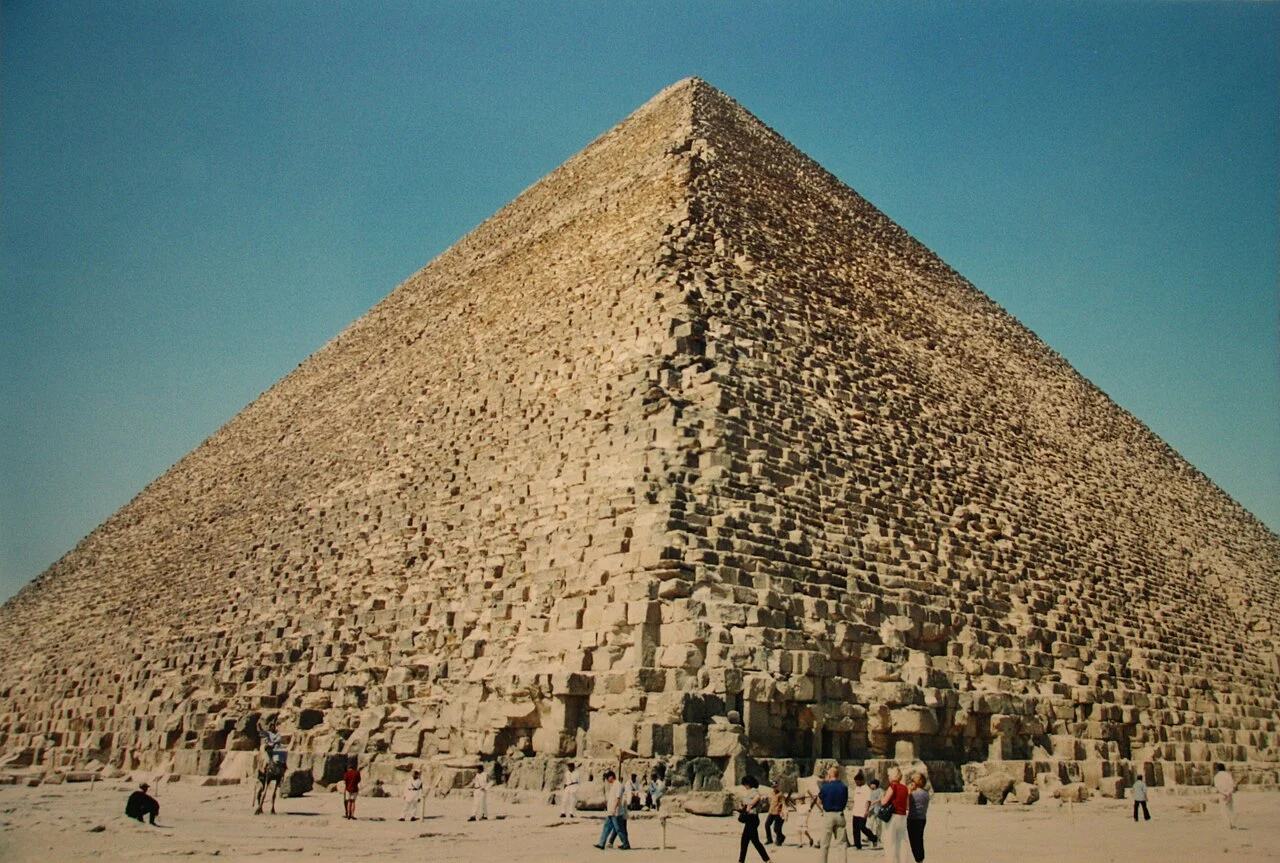
The Great Pyramid of Giza was raised for Khufu, a king of Egypt’s 4th Dynasty who reigned from roughly 2589 to 2566 BCE. Historians usually place the pyramid’s completion around 2560 BCE. It was so large that it remained the tallest structure built by human hands for thousands of years, and it is the only one of the Seven Wonders of the Ancient World still standing.
By the time Cleopatra VII was born in 69 BCE, the pyramid was already about 2,500 years old. For her, it was a relic of a distant past, much as the Roman Colosseum or the Great Wall is for us, only far older.
The last queen of independent Egypt
Cleopatra belonged to the Ptolemaic dynasty, a line of Greek-speaking rulers descended from one of Alexander the Great’s generals. She took the throne in 51 BCE and ruled until her death in 30 BCE, after which Rome annexed Egypt as a province. Her alliances with Julius Caesar and Mark Antony made her one of the best known figures of the ancient world, but she lived at the very end of Egypt’s long story as an independent kingdom, not at its start.
Doing the arithmetic
From the pyramid’s completion around 2560 BCE to Cleopatra’s death in 30 BCE is roughly 2,530 years. From 30 BCE to 20 July 1969, when the Apollo 11 lunar module touched down on the Moon, is about 1,998 years, since the calendar has no year zero. That means the gap between Cleopatra and Neil Armstrong is around 500 years shorter than the gap between Cleopatra and the builders of the Great Pyramid.
Why it surprises us
Our sense of history tends to compress anything older than a few centuries into one blurry era called the ancient past. The pharaonic state, however, lasted for close to 3,000 years, with dynasties rising and falling, capitals moving and the language and religion changing along the way. Cleopatra herself was the first ruler of her dynasty said to have learned the Egyptian language, a sign of how much Egypt had changed since Khufu’s day.
Keeping these spans in mind makes the achievements of the pyramid builders even more striking. Their monument had already outlasted dozens of dynasties when Cleopatra ruled, and it has now stood for more than 4,500 years.
Key points
- The Great Pyramid was built for the pharaoh Khufu, who reigned from about 2589 to 2566 BCE.
- Cleopatra VII was born in 69 BCE, ruled from 51 BCE and died in 30 BCE.
- About 2,530 years passed between the pyramid's completion and Cleopatra's death.
- About 2,000 years passed between Cleopatra's death and Apollo 11 landing on the Moon on 20 July 1969.
- Cleopatra was the last ruler of Egypt before it became a province of Rome.
Sources
- Great Pyramid of Giza, World History Encyclopedia
- Cleopatra VII, World History Encyclopedia
- July 20, 1969: One Giant Leap For Mankind, NASA
Image: Gary Todd, CC0, via Wikimedia Commons