
3 min read
In September 2007, about 3,000 tiny animals called tardigrades rode outside a capsule in low Earth orbit for 12 days, and many survived the vacuum and cosmic radiation of space, making them the first animals known to do so.
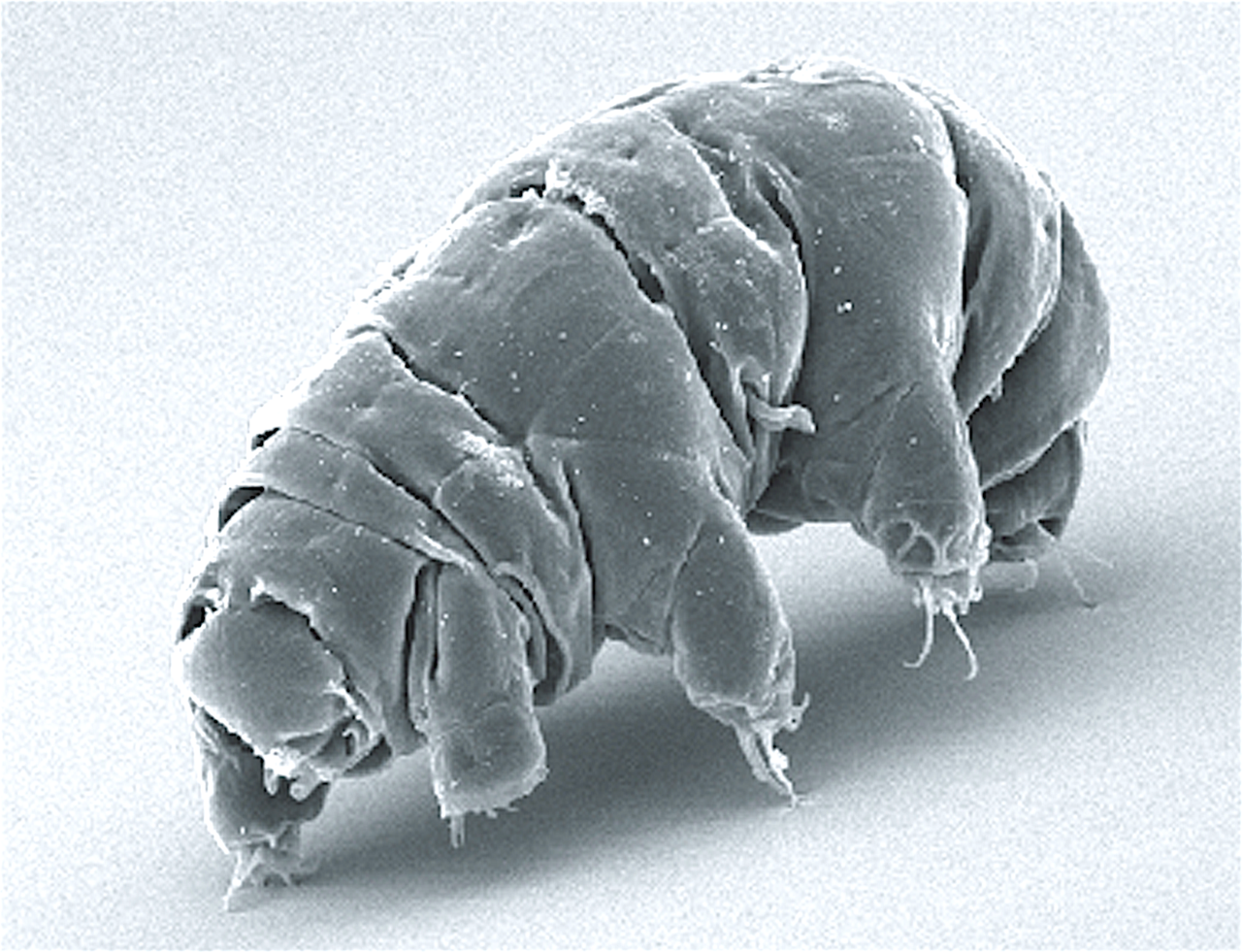
Tardigrades are among the smallest animals on Earth, and among the toughest. Nicknamed water bears for their plump bodies and lumbering walk, they live in films of water on moss, lichen, soil and leaf litter almost everywhere on the planet. In 2007 scientists sent some of them somewhere far harsher than any pond: the outside of a spacecraft in orbit.
Small but extraordinarily hardy
A tardigrade has a segmented body and eight stubby legs tipped with claws, and the largest species are only a little over a millimetre long. What makes them famous is their ability to shut down when conditions turn bad. When their surroundings dry out, many species pull in their legs, lose almost all their body water and curl into a dry, barrel-shaped state known as a tun. In this state they can reportedly endure temperatures from close to absolute zero up to about 150 degrees Celsius, go without water for around a decade and tolerate high doses of radiation.
The TARDIS experiment
Knowing how robust the animals are, Swedish and German researchers designed an experiment called Tardigrades in Space, or TARDIS. In September 2007, about 3,000 dried water bears flew on the European Space Agency’s Foton-M3 mission, an uncrewed capsule that orbited Earth for 12 days. The animals rode in an exposure facility on the outside of the capsule, where they faced the vacuum of space, extreme dehydration and cosmic radiation.
When the capsule returned, the team rehydrated the animals and checked them. Project leader Ingemar Jönsson of Kristianstad University in Sweden summed up the main finding: the vacuum of space and cosmic radiation were not a problem for the water bears. The study was published in the journal Current Biology in 2008, and it made tardigrades the first animals known to survive direct exposure to space.
Why it matters
Before the experiment, only a handful of hardy organisms, such as some bacterial spores, lichens and seeds, had been shown to withstand space conditions. Finding an animal on that list raised new questions. Researchers want to understand how tardigrade cells protect their membranes and DNA when they dry out, knowledge that could help with storing vaccines and other biological materials without refrigeration, or protecting living things on long space missions.
The result also feeds into a bigger debate about how sturdy life can be and whether simple organisms could ever survive a journey between worlds. Space agencies have since continued exposure experiments on the outside of the International Space Station to test how long such survivors can last.
Key points
- Tardigrades, also called water bears, are segmented animals, with the largest species just over a millimetre long.
- They can survive temperatures from about minus 272 to plus 150 degrees Celsius and go years without water.
- In 2007 about 3,000 of them flew for 12 days on the European Space Agency's Foton-M3 mission.
- Researchers found that the vacuum of space and cosmic radiation did not stop them surviving.
- The results, published in Current Biology in 2008, made them the first animals shown to survive exposure to space.
Sources
- Tiny animals survive exposure to space, European Space Agency
- Spacesuits optional for 'water bears', Nature
- Tardigrades survive exposure to space in low Earth orbit, Current Biology
Image: Schokraie E, Warnken U, Hotz-Wagenblatt A, Grohme MA, Hengherr S, et al., CC BY 2.5, via Wikimedia Commons