
3 min read
On 15 January 1919 a storage tank in Boston's North End burst, releasing about 8.7 million litres of molasses in a wave that killed 21 people and injured about 150.
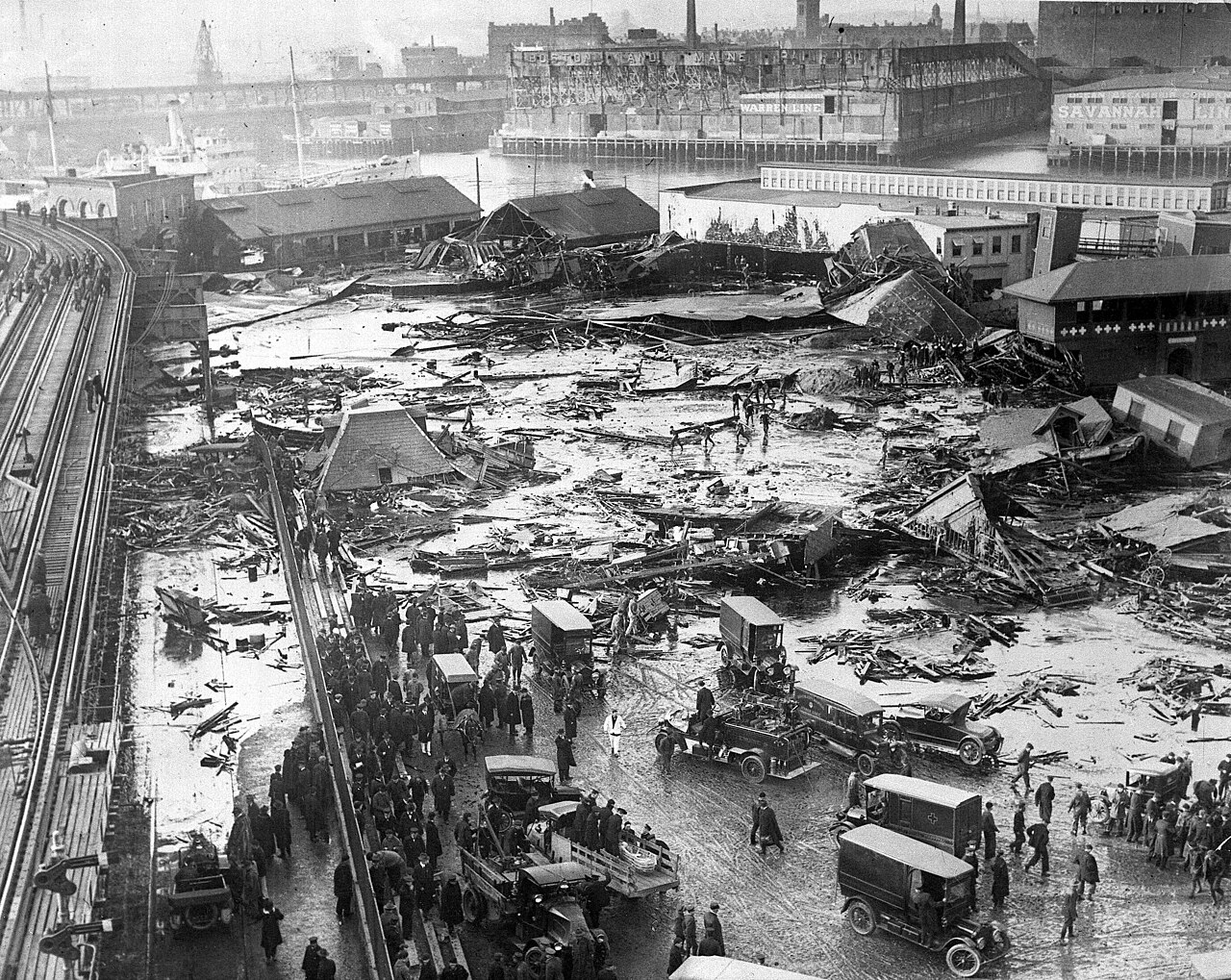
Shortly after midday on 15 January 1919, a huge steel tank on Commercial Street in Boston’s North End split apart. Out came a brown wall of molasses that flattened buildings and swept people and horses off their feet. By the time it settled, 21 people were dead and about 150 were injured.
The tank that should never have stood
The tank belonged to the Purity Distilling Company, a subsidiary of United States Industrial Alcohol. Built in 1915, it stood about 15 metres tall and 27 metres across and could hold up to 2.5 million US gallons. Molasses was valuable as a raw material for industrial alcohol, and the tank was kept busy.
It was also badly built. According to Britannica, the structure leaked and groaned from the start, yet it stayed in service. When it failed, it released roughly 8.7 million litres, or about 2.3 million US gallons. Reported heights for the wave vary widely, from about 5 to 12 metres, but it moved at about 56 kilometres per hour, far faster than anyone could run.
Why a sticky flood was so lethal
Molasses seems like a slow, harmless substance, which is exactly why the disaster puzzled people for decades. In 2016, fluid dynamicist Nicole Sharp, working with Jordan Kennedy and Shmuel Rubinstein of Harvard University, presented an explanation at the American Physical Society’s Division of Fluid Dynamics meeting in Portland, Oregon.
Their analysis centred on temperature. The air in Boston that day was around 5 degrees Celsius. A fresh shipment had arrived two days earlier, and the molasses inside the tank was probably between 10 and 20 degrees Celsius, warm enough to flow quickly. Once it spilled into the cold streets it began to lose heat. Molasses becomes dramatically thicker as it cools, and the team estimated its viscosity could have risen by a factor of four or more. Gravity alone, they found, provided enough force to explain how fast the first surge travelled.
That combination proved deadly. The initial wave hit with great speed and weight, and then the spreading liquid stiffened around anyone caught in it. Many victims died by suffocation. Rescuers struggled to wade in, and temperatures fell below freezing the following night, making the clean-up even harder.
How we know what happened
The physics study rested on historical records, including survivor testimony, photographs of the damage and maps of how far the molasses spread. The researchers compared their models of how cooling molasses would flow with those accounts, and the results matched the historical evidence reasonably well.
The legal record is just as revealing. Survivors and families sued the parent company, which claimed the tank had been sabotaged by anarchists. Investigators found no support for that story. In 1925, after years of hearings, the court ruled that the tank had been structurally unsound and ordered the company to pay damages.
A disaster that changed building rules
The flood had a lasting effect well beyond Boston. Because the tank had gone up without proper engineering checks, the case pushed authorities toward stricter oversight. Britannica notes that it led to tougher construction codes across the United States.
Today a small historical marker near the waterfront records what happened. The event is sometimes treated as a quirky footnote, but it was a serious industrial disaster caused by cutting corners. Its lesson remains plain. Ordinary materials can become dangerous at scale when nobody checks the container holding them.
Key points
- The Purity Distilling Company tank burst on 15 January 1919, around lunchtime.
- About 8.7 million litres (some 2.3 million US gallons) of molasses poured into the streets at about 56 km/h.
- Twenty-one people died and about 150 were injured.
- A 2016 study showed that cold air thickened the molasses, trapping victims and hampering rescuers.
Sources
- Great Molasses Flood, Encyclopaedia Britannica
- January 15, 1919: Physics and the Boston Molasses Flood, American Physical Society (APS News)
- Great Molasses Flood of 1919: Why This Deluge of Goo Was So Deadly, Live Science
Image: Boston Public Library, Public domain, via Wikimedia Commons