
3 min read
A honeybee that finds good flowers far from the hive performs a waggle dance: the angle of her straight run from vertical shows the direction of the food relative to the sun, and the length of the run shows how far away it is.
A hive is dark and crowded, and a bee that has just found a rich patch of flowers cannot point. Instead she dances. On the vertical surface of the wax comb, she runs through a pattern that other workers follow closely, and the pattern carries two pieces of information: which way to fly and how far to go.
Three kinds of dance
According to apiculture specialists at North Carolina State University, the form of the dance depends on distance. For food less than about 50 metres from the hive, a forager performs a round dance, running in tight circles and reversing direction. That says the food is close but gives no direction. Between about 50 and 150 metres she switches to a crescent-shaped sickle dance. Beyond about 150 metres she performs the waggle dance, a figure of eight with a straight run through the middle.
During that straight run the bee waggles her body, especially her abdomen, from side to side and gives off a low buzzing sound made by her wings. Then she loops back in a semicircle, repeats the straight run, and loops back the other way.
Reading the direction
The direction is the clever part. The angle of the straight run, measured from vertical on the comb, matches the angle between the food and the sun outside. A run straight up means fly towards the sun. A run straight down means fly away from it. A run 60 degrees to the left of vertical means the flowers lie 60 degrees to the left of the sun. In effect, the bee translates the position of the sun into the direction of gravity.
Because the sun moves across the sky, the same patch of flowers is danced differently through the day. Food due east of a hive would be danced roughly straight up in the morning and roughly straight down by late afternoon.
Reading the distance
Distance is encoded by time. The longer the waggling part of the run lasts, the farther away the food. The NC State guide gives an example: a waggle run of about 2.5 seconds points to a source around 2,625 metres away. Later studies have found the relationship can flatten at longer distances, but the principle holds.
A Nobel-winning discovery
The Austrian zoologist Karl von Frisch began describing the dances in the 1920s and spent decades testing them with glass-walled observation hives and bees trained to feeders at known distances. In 1973 he shared the Nobel Prize in Physiology or Medicine with Konrad Lorenz and Nikolaas Tinbergen for their discoveries about animal behaviour.
The dance is not the whole story. Researchers have shown that recruits also use the scent of flowers carried on the dancer’s body to home in once they reach the right area. Even so, the waggle dance remains one of the most remarkable examples of animal communication ever decoded: a symbolic map, drawn in movement, in total darkness.
Key points
- Foragers returning from rich food sources dance on the vertical wax comb to recruit other workers.
- For food more than about 150 metres away, the bee performs a figure-of-eight waggle dance that encodes both distance and direction.
- The angle of the waggle run from straight up equals the angle between the food and the sun outside.
- The longer the waggle run lasts, the farther away the food is; a run of about 2.5 seconds points to food roughly 2.6 kilometres away.
- Karl von Frisch decoded the dance and shared the 1973 Nobel Prize in Physiology or Medicine.
Sources
- The Honey Bee Dance Language, NC State Extension
- Karl von Frisch: Facts, NobelPrize.org
- Honey bees communicate distance via non-linear waggle duration functions, PubMed Central, US National Library of Medicine
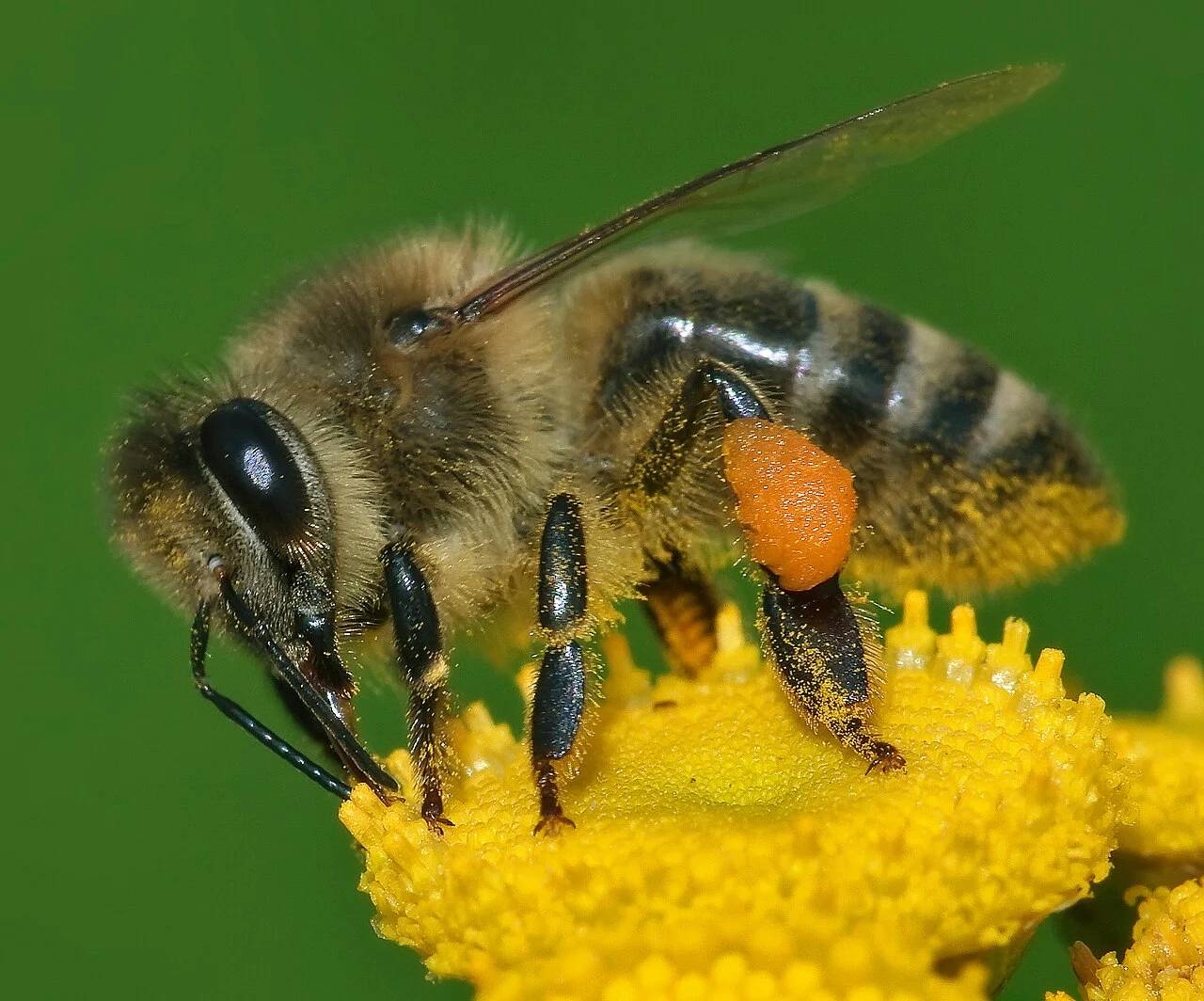
Image: Andreas Trepte, CC BY-SA 2.5, via Wikimedia Commons