
3 min read
The head of a Prince Rupert's drop can withstand a hammer blow, yet snapping its thin tail makes the whole glass drop burst into powder within microseconds.
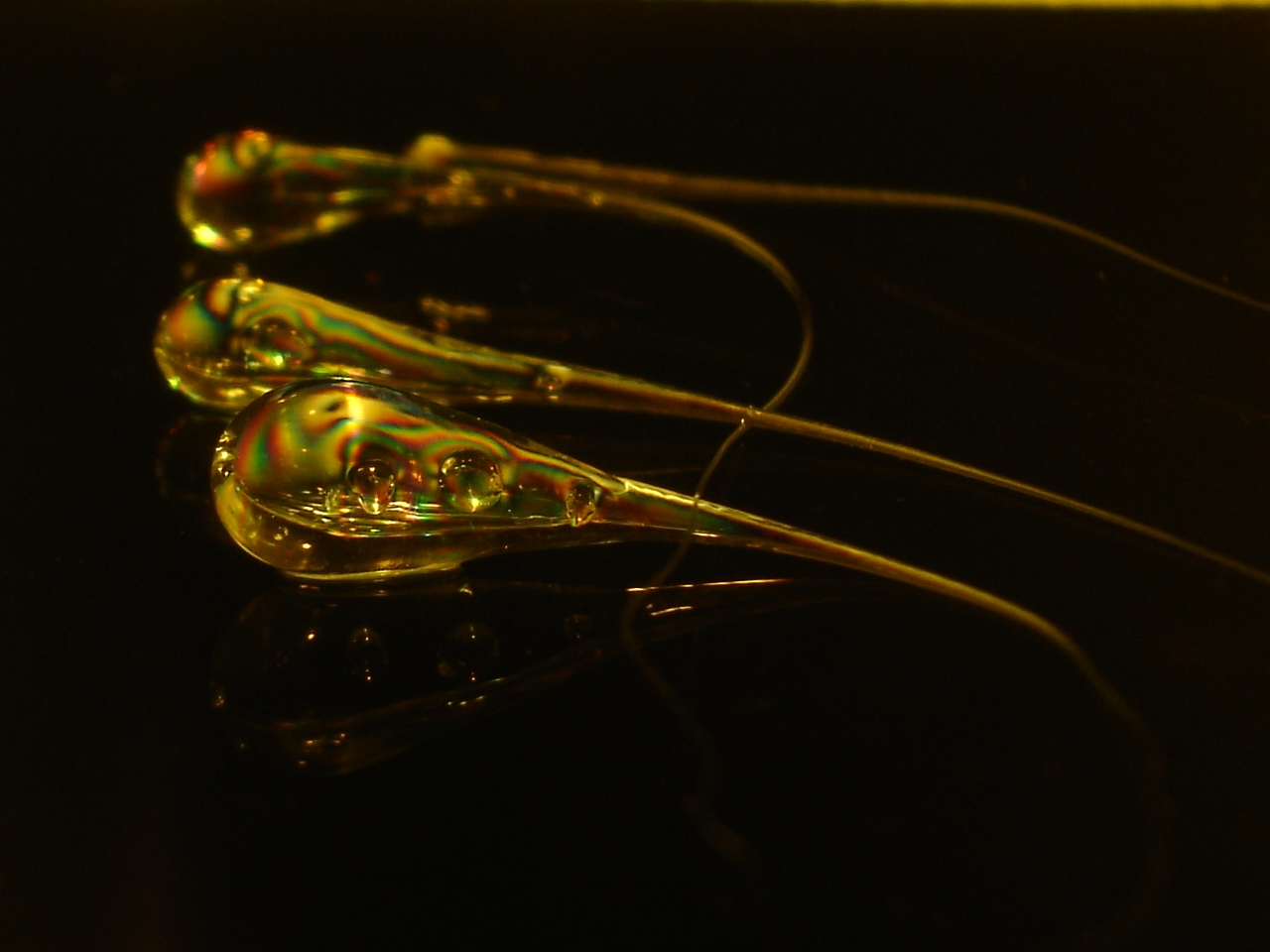
Prince Rupert’s drops look like small glass tadpoles, with a rounded head and a long, thin tail. Hit the head with a hammer and it will usually survive. Snap the tail with your fingers, however, and the entire drop explodes into fine powder with a sharp pop.
How the drops are made
The recipe is simple. A blob of red hot molten glass, typically soda lime or flint glass, is dropped into a bucket of cold water. As it falls and cools, it stretches into the familiar tadpole shape, with a finished length of about 10 centimetres. This rapid cooling is called quenching.
Quenching is the secret to the drop’s odd behaviour. The outer surface touches the water first and hardens almost at once, while the interior is still hot and soft. As the inside later cools, it shrinks and pulls on the solid outer shell. The result is a drop whose surface is squeezed together in compression, while its core is stretched in tension. The whole object sits in an unstable balance between these two opposing forces.
Why the head is so strong
Glass normally breaks when a crack opens and grows, and that needs tension. Compression works against it by pushing the sides of any crack closed. In 2017 a team led by Hillar Aben of Tallinn University of Technology, working with Srinivasan Chandrasekar of Purdue University and Munawar Chaudhri of the University of Cambridge, measured the stresses inside the head for the first time in detail. They published their findings in the journal Applied Physics Letters.
The researchers placed drops in a clear liquid, shone red light through them and viewed them through polarising filters. Stress in glass changes how light passes through it, producing coloured bands that can be converted into precise numbers. They found that the surface of the head is compressed by up to 700 megapascals, nearly 7,000 times atmospheric pressure. Purdue described this as about 50 tons per square inch, similar to some grades of steel. The compressed layer is only about a tenth of the head’s diameter, but it is enough. Cracks that start on the surface tend to run parallel to it and cannot reach the tense interior.
What happens when the tail breaks
The tail is the weak point. It is so thin that a little finger pressure snaps it, and this opens a path straight into the zone of tension inside. Once a crack reaches that region, the stored energy is released and fractures spread through the drop in a chain reaction. In 1994 Chandrasekar and Chaudhri filmed the process with a camera running at nearly a million frames per second. They found that the cracks travel from the tail to the head at more than 4,000 miles per hour, turning the drop to dust in a few microseconds.
Four centuries of curiosity
The drops have puzzled people since the 17th century. They take their name from Prince Rupert, who brought several of them to England and presented them to King Charles II, who was intrigued by their strange properties. Explanations came and went for centuries, and even in 2013 some published papers offered incorrect accounts of their strength.
The same principle is now used every day. Toughened glass for car windows and phone screens is made by building a layer of compression into the surface, a technique first patented in the 19th century. Prince Rupert’s drops are an early, natural demonstration of how locked in stress can make glass far stronger than it looks.
Key points
- Prince Rupert's drops are made by dripping molten glass into cold water, which cools the outside much faster than the inside.
- The surface of the head is under compressive stress of up to 700 megapascals, around 50 tons per square inch.
- Breaking the tail lets cracks reach the tension zone inside, and they race through the drop at more than 4,000 miles per hour.
- Prince Rupert brought the drops to King Charles II of England in the 17th century, and their strength was fully explained only in 2017.
Sources
- A hammer can't break this tadpole-shaped piece of glass, Purdue University
- Scientists solve 400-year-old mystery of Prince Rupert's drops, Phys.org
Image: Mg3kc at English Wikipedia, Public domain, via Wikimedia Commons