
3 min read
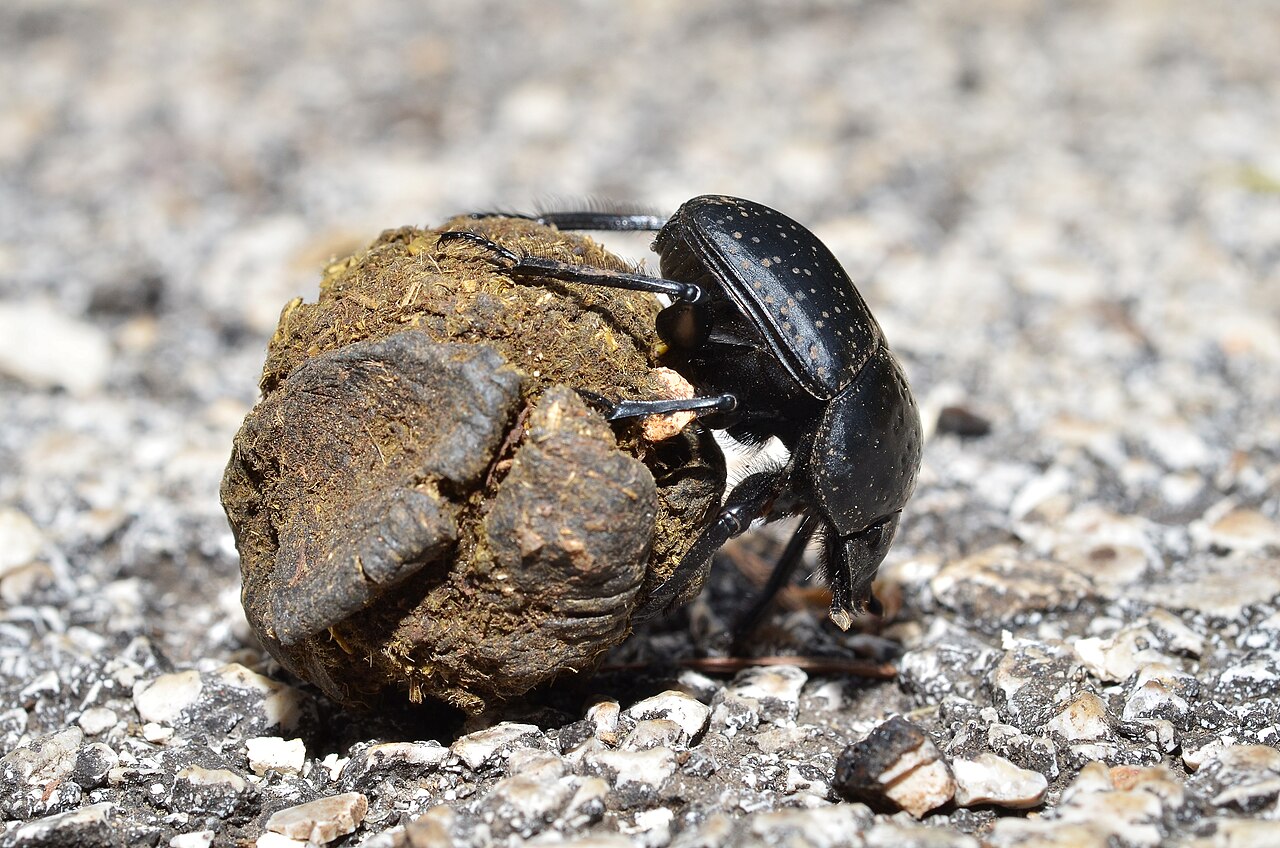
African dung beetles use the glow of the Milky Way to roll their dung balls in straight lines at night, the first animals shown to orient using our galaxy.
A dung beetle has a simple goal once it has shaped a ball of dung: get away from the dung pile as quickly as possible before a rival steals its prize. The fastest escape is a straight line. In 2013 scientists showed that some African dung beetles manage this on dark nights by steering by the Milky Way.
Why a straight line matters
Dung piles attract crowds of beetles, and fights over balls are common. A beetle that wanders in circles risks ending up back where it started. Marcus Byrne of the University of the Witwatersrand (Wits) in South Africa put it bluntly, saying the beetles do not care which direction they go, they just need to get away from the scramble at the dung pile. Earlier research had already shown that these insects use the Sun, the Moon and patterns of polarised light to hold their course. Yet many still rolled straight on clear nights with no Moon at all.
Testing beetles under the stars
A team led by Marie Dacke of Lund University in Sweden, with colleagues from Wits and the University of Pretoria, studied the species Scarabaeus satyrus. In field tests near Vryburg in South Africa, the beetles kept straight paths under starlit skies but lost their way when the sky was overcast. When the researchers fitted the beetles with small caps that blocked their view of the sky, the insects wandered aimlessly.
Timing made the difference clear. On nights when the Milky Way was visible, beetles could cross a circular arena 2 metres wide in as little as 40 seconds. On cloudy nights the same journey took close to 2 minutes.
Inside the planetarium
To find out exactly which lights the beetles were using, the team moved the experiment indoors to the planetarium at Wits University in Johannesburg, where they could control the night sky. They projected different views overhead and watched how well the beetles rolled. The insects did just as well under the Milky Way alone as under a full starry sky. When only a few of the brightest stars were shown, their performance dropped.
This suggested the beetles rely on the broad band of light that the Milky Way forms across the sky rather than on a handful of bright points. Because the galaxy is so far away, its position barely shifts as the beetle moves, so keeping it at a fixed angle produces a straight path. A nearby light, such as a candle, would have the opposite effect and send an insect circling, much as moths do around lamps.
A first for the animal kingdom
The results were published in the journal Current Biology in January 2013. Birds, seals and humans were already known to use stars to orient themselves, but the authors described their study as the first convincing evidence of starry sky orientation in insects. It was also the first documented case of any animal using the Milky Way to find its way. When both the Moon and the Milky Way are visible, the beetles probably favour the Moon, the brighter of the two.
The work shows how much a tiny insect brain can achieve. Without a map or a destination in mind, a beetle only needs one steady reference point overhead, and on a clear moonless night in southern Africa our own galaxy provides it.
Key points
- A 2013 study in Current Biology showed that African ball-rolling dung beetles use the Milky Way to keep a straight course at night.
- Beetles rolled straight under clear starry skies but wandered under overcast skies or when small caps blocked their view upwards.
- In the Wits University planetarium the beetles oriented just as well under the Milky Way alone as under a full starry sky.
- The researchers called it the first known use of the Milky Way for orientation in the animal kingdom.
Sources
- Dung Beetles Use the Milky Way for Orientation, Lund University (Current Biology publication record)
- Dung beetles follow the Milky Way, ScienceDaily (University of the Witwatersrand)
- Dung Beetles Use Milky Way for Orientation, Sci.News
Image: Gilles San Martin, CC BY-SA 3.0, via Wikimedia Commons