
3 min read
Until 20 May 2019, the kilogram was defined by a single platinum-iridium cylinder near Paris; it is now defined by fixing the Planck constant at exactly 6.62607015 × 10^-34 kg m² s^-1.
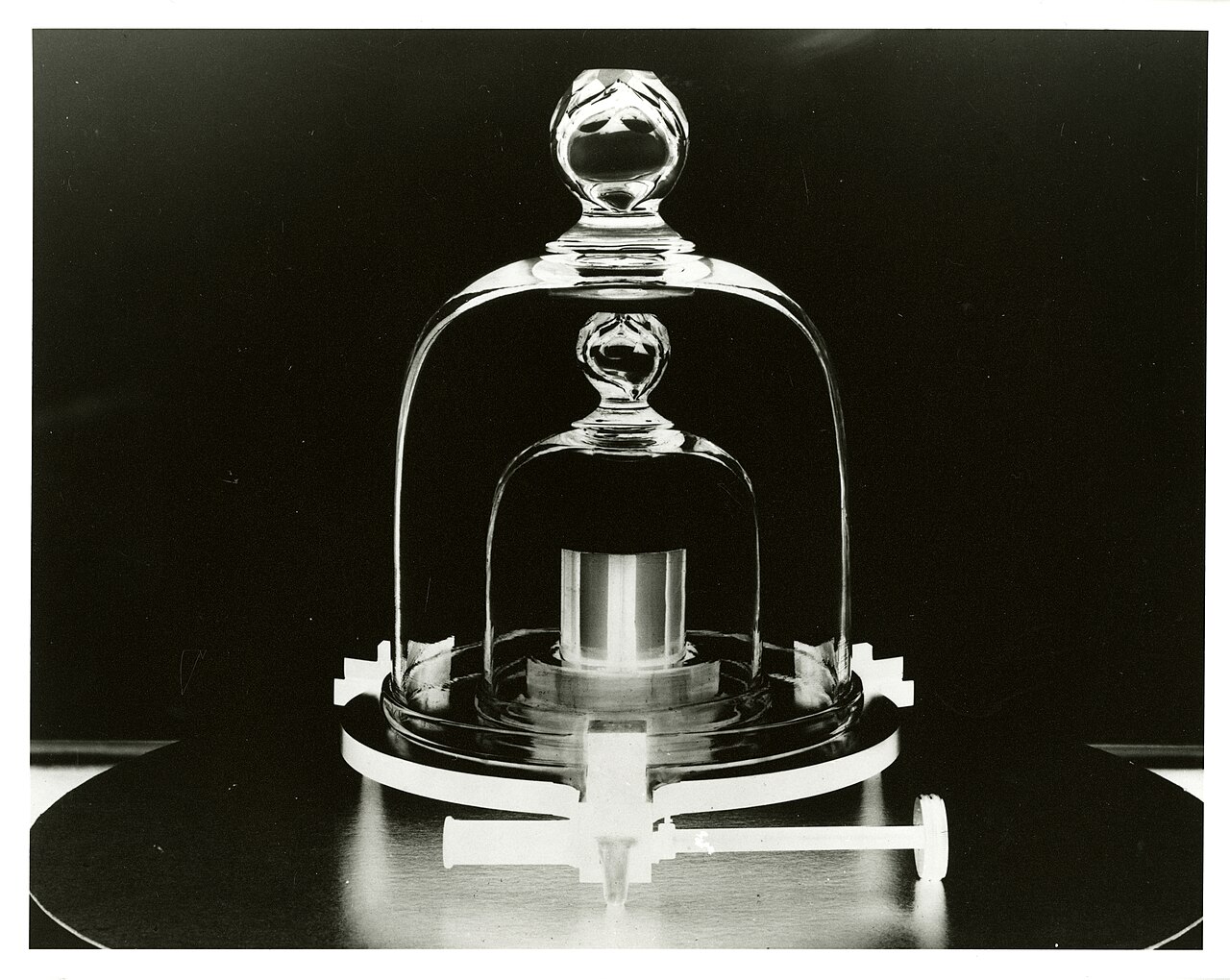
For 130 years, the official kilogram was not an idea or an equation. It was a single metal cylinder kept under glass in a basement near Paris, and every scale on Earth ultimately answered to it. On 20 May 2019, that object lost its job.
The last unit tied to a physical thing
The International Prototype of the Kilogram, nicknamed Le Grand K, is a small cylinder of platinum and iridium. It became the world’s reference for mass in 1889 and was stored at the International Bureau of Weights and Measures in Sèvres, on the edge of Paris. The vault holding it sits under three nested bell jars, and opening it requires three separate keys.
By the late twentieth century, the metre had already been redefined using the speed of light and the second using the vibrations of caesium atoms. The kilogram was the last base unit of the metric system still defined by a manufactured artefact. If Le Grand K gained a speck of dust or lost a few atoms during cleaning, then by definition the entire world’s kilogram changed with it.
Why the cylinder had to go
Metrologists periodically compared Le Grand K with its official sister copies, which were distributed to national laboratories around the world. Over roughly a century, most of those copies drifted relative to the original, on average by around 50 micrograms. Nobody could say for certain whether the copies had gained mass or the master had lost it, because there was nothing more fundamental to check against.
Fifty micrograms sounds trivial for an object weighing a kilogram. For modern science and industry, it is not. Pharmaceutical dosing, precision manufacturing and fundamental physics experiments increasingly demand accuracy at the microgram level, and a reference that wanders on its own undermines all of them. The US National Institute of Standards and Technology points to this slow drift as a basic weakness of any standard that depends on a physical object.
How a constant of nature replaced it
On 16 November 2018, delegates at the 26th General Conference on Weights and Measures in Versailles voted to redefine the kilogram. The new definition took effect on 20 May 2019. Instead of pointing to an object, the kilogram is now defined by fixing the value of the Planck constant, a number from quantum physics, at exactly 6.62607015 × 10⁻³⁴ kilogram square metres per second.
Because the metre and the second were already pinned to constants of nature, fixing the Planck constant locks the kilogram into place as well. Laboratories can now realise a kilogram from first principles with instruments such as the Kibble balance, which balances the weight of a mass against an electromagnetic force that can be measured in terms of the Planck constant. In principle, any well-equipped lab anywhere can do this without ever travelling to France.
What changed in daily life, and what did not
Your bathroom scale did not notice. The new value of the Planck constant was chosen so that the redefined kilogram matched the old one as closely as measurements allowed, and supermarket weights carried on exactly as before. The change is about stability over decades and centuries, not about anything a shopper could detect.
The same vote also redefined three other base units. The ampere is now tied to the charge of the electron, the kelvin to the Boltzmann constant and the mole to the Avogadro constant. For the first time, every unit in the International System rests on fixed constants rather than objects or material samples.
Le Grand K still exists and is still kept in its vault. In a neat reversal, it is now the cylinder that carries a measurement uncertainty, of about plus or minus 10 micrograms, because its mass is judged against the constant rather than the other way round. The object that once defined mass for the entire planet has become just another very carefully made weight.
Key points
- Le Grand K, a platinum-iridium cylinder, defined the kilogram from 1889 until 2019.
- Its official copies drifted by around 50 micrograms on average over roughly a century.
- Since 20 May 2019, the kilogram has been defined by a fixed value of the Planck constant.
- The ampere, kelvin and mole were redefined in the same 2018 vote.
Sources
- It's official: We're redefining the kilogram, Science News
- Kilogram, National Institute of Standards and Technology (NIST)
- SI base unit: kilogram (kg), International Bureau of Weights and Measures (BIPM)
Image: National Institute of Standards and Technology, Public domain, via Wikimedia Commons