
3 min read
Welwitschia mirabilis of the Namib Desert grows just two leaves in its entire life, and they keep growing from the base for centuries, with some plants over 1,500 years old.
In the coastal desert of Namibia and southern Angola grows one of the most unusual plants on Earth. Welwitschia mirabilis produces only two leaves in its entire life, and it never replaces them. Instead, those two leaves keep growing for centuries, sometimes for well over a thousand years.
A very simple body
A welwitschia has a remarkably plain structure. According to the Royal Botanic Gardens, Kew, it consists of two leaves, a woody stem base and a deep taproot. The plant is usually less than a metre tall, though it can occasionally reach about two metres.
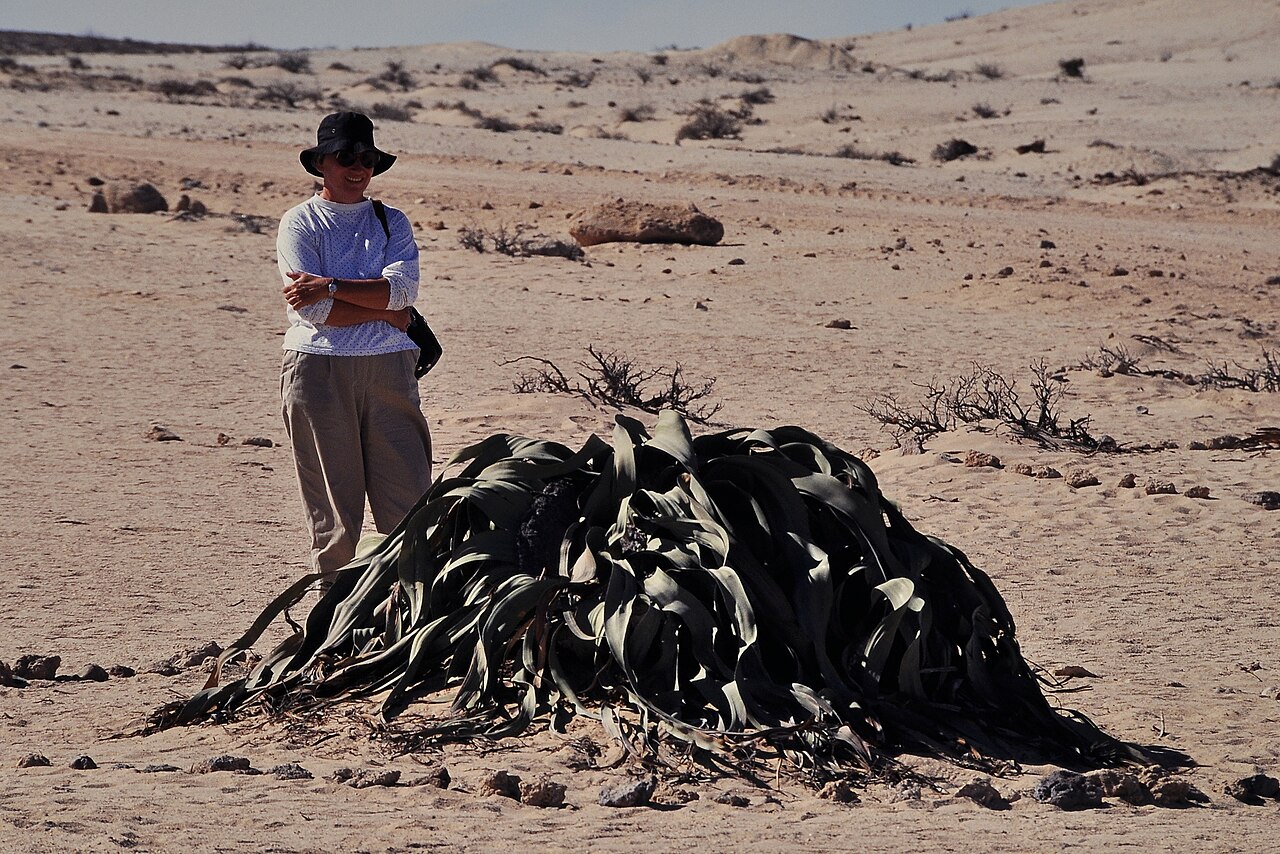
The two leaves that appear after germination are the only ones the plant will ever have. They grow out sideways from the stem base and spread across the ground. Over time the desert wind and sun tear them along their length into long ribbons, which twist and curl. An old welwitschia can therefore look like a tangled heap of many leaves, and it has been described as looking like an octopus. Weathering wears away the tips, so the leaves rarely extend more than a few metres.
Leaves that never stop growing
The secret lies at the base of each leaf, where a band of growing tissue keeps producing new leaf material. As the old tips die back and break off, fresh tissue pushes out from behind. A 2021 study in the journal Nature Communications, led by Tao Wan, reported that the plant grows slowly, at roughly 10 to 13 centimetres a year. The authors described the leaves as the longest lived in the plant kingdom, lasting several thousand years.
Carbon dating of some of the largest individuals shows they are more than 1,500 years old. Kew notes that certain giant plants, known locally as tree tumbos, are believed to be over 1,000 years old. This long life helps the species survive even though it grows slowly and produces few young plants.
Surviving in the Namib
Welwitschia is found only in the Namib Desert, usually within a few hundred kilometres of the coast, from south west Angola into north west and west central Namibia. The region receives less than 50 millimetres of rain a year. The plant relies on long taproots that reach for underground water, while its leaves can capture moisture from the sea fogs that drift inland. In droughts, animals such as oryx, springbok and Hartmann’s zebra chew the leaves for water and nutrients, and small reptiles and insects shelter beneath them.
Male and female cones grow on separate plants. A fungus that attacks female cones and seeds greatly reduces the number of viable seeds, which is one reason new plants are scarce.
Clues in its genes
The 2021 genome study helped explain how welwitschia manages its extraordinary lifespan. The researchers found that its whole genome was duplicated around 86 million years ago, an event unique to welwitschia among its close relatives. About 55 per cent of its DNA is made of repeating elements called retrotransposons, and the plant carries some of the highest levels of DNA methylation, a kind of chemical tagging, ever reported in a plant. Families of genes linked to growth, stress tolerance and longevity have also expanded.
Welwitschia is the only species in its plant family. The IUCN currently lists it as Least Concern, but off road vehicles, collecting and overgrazing remain threats. It is protected in national parks in Namibia and Angola, where it continues its slow growth on the gravel plains.
Key points
- Welwitschia mirabilis has a body made of just two leaves, a stem base and a long taproot.
- Its two leaves grow continuously from the base throughout the plant's life, and weather splits them into ribbons that look like many leaves.
- Carbon dating shows some of the largest plants are more than 1,500 years old.
- A 2021 genome study in Nature Communications linked its longevity to an ancient genome duplication and genes for stress tolerance.
Sources
- Welwitschia mirabilis: general information, Royal Botanic Gardens, Kew (Plants of the World Online)
- The Welwitschia genome reveals a unique biology underpinning extreme longevity in deserts, Nature Communications (via PubMed Central)
Image: Schnobby, CC BY-SA 3.0, via Wikimedia Commons