
4 min read
Satellite data from 2007 to 2013 show about 27.7 million tonnes of Saharan dust settle on the Amazon basin yearly, delivering roughly 22,000 tonnes of phosphorus, about what the forest loses to rain and flooding.
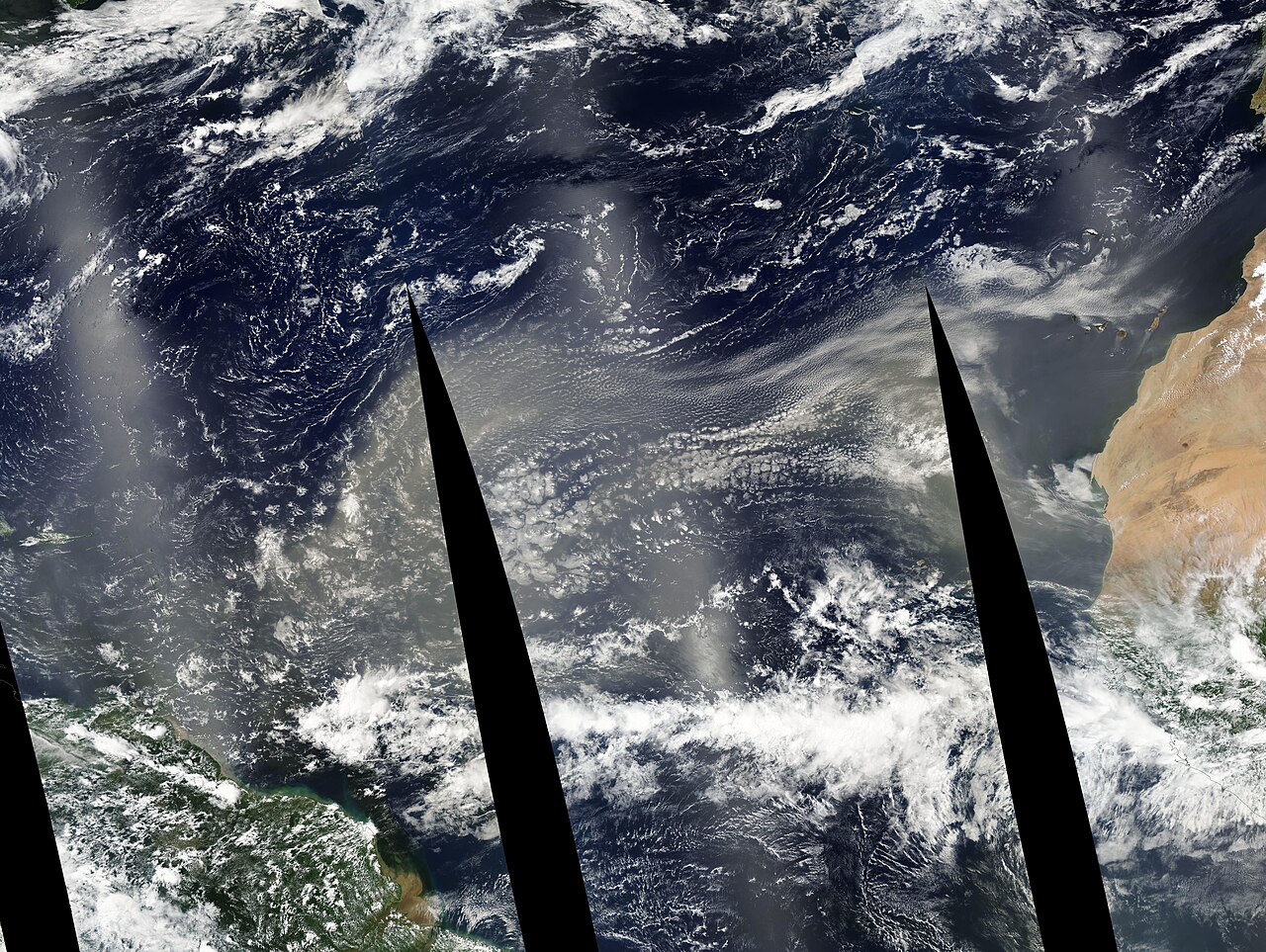
The Amazon rainforest is often called the lungs of the planet, but part of what keeps it growing arrives from one of the driest places on Earth. Every year, wind carries millions of tonnes of dust from the Sahara across the Atlantic Ocean and drops it over the Amazon basin. That dust contains phosphorus, a nutrient the rainforest cannot easily hold on to by itself.
A transatlantic delivery of nutrients
A NASA-led study published in Geophysical Research Letters in February 2015 put numbers on this long-distance supply line for the first time using several years of satellite data. On average, about 182 million tonnes of dust are lifted from the Sahara each year and carried west past the edge of the desert. By the time the plume reaches the coast of South America, about 132 million tonnes are still in the air.
Of that, an estimated 27.7 million tonnes settle onto the Amazon basin each year. Another 43 million tonnes or so travel further and fall over the Caribbean Sea. NASA described the Amazon’s share as enough dust to fill more than 100,000 semi-trailer trucks.
Why phosphorus is the key ingredient
Most of that dust is simply fine mineral particles, but a small fraction is phosphorus. Plants need phosphorus to build DNA, cell membranes and the molecules that store energy, and in many tropical forests it is in short supply. Heavy rain and seasonal flooding in the Amazon constantly wash nutrients out of the soil and into rivers.
The researchers estimated that the dust delivers about 22,000 tonnes of phosphorus to the Amazon basin every year. That figure roughly matches the amount the forest loses through rain and flooding over the same period. In other words, the Sahara appears to be topping up a nutrient account that would otherwise slowly drain.
Much of the phosphorus-rich dust comes from a single area, the Bodélé Depression in Chad. It is the bed of an ancient lake, and its sediments are made up largely of the remains of dead microorganisms, which are rich in phosphorus. Strong winds funnel through the basin and loft this material high into the atmosphere.
How scientists measured it
The study, led by Hongbin Yu of the University of Maryland and NASA’s Goddard Space Flight Center, used data from CALIPSO, a satellite that carries a lidar instrument. Lidar works by firing pulses of laser light and timing their reflections, which lets it build a vertical profile of particles in the atmosphere. That allowed the team to track the dust plume in three dimensions rather than simply seeing a haze from above.
The analysis covered seven years of observations, from 2007 to 2013. To convert dust into nutrients, the researchers used measurements of phosphorus content from samples taken in the Bodélé Depression and from ground stations on Barbados and in Miami, which sit under the path of the plume.
A supply that rises and falls
The delivery is far from steady. The amount of dust crossing the ocean varied by 86 percent between the dustiest year in the record, 2007, and the least dusty, 2011. The team also found a link with rainfall in the Sahel, the semi-arid belt along the Sahara’s southern edge. Wet years in the Sahel tended to be followed by years with less dust transport.
The researchers suggested two possible explanations. More rain could mean more vegetation and less bare soil for the wind to erode, or the rainfall could be connected to wind patterns that affect how much dust is lifted. Either way, the finding links the health of one of the wettest ecosystems on Earth to weather in one of the driest.
The study does not mean the Amazon would collapse without the Sahara, and scientists continue to refine the numbers. But it shows how ecosystems separated by an ocean can be bound together by the atmosphere, with a desert quietly helping to feed a rainforest thousands of kilometres away.
Key points
- About 27.7 million tonnes of Saharan dust settle on the Amazon basin each year.
- The dust delivers roughly 22,000 tonnes of phosphorus annually, about what the forest loses to rain and floods.
- Much of it comes from the Bodélé Depression, an ancient lake bed in Chad.
- NASA's CALIPSO satellite tracked the plume in 3D from 2007 to 2013.
Sources
- Satellite Tracks Saharan Dust To Amazon In 3-D, NASA Goddard Scientific Visualization Studio
- Phosphorus-Rich Dust from Sahara Desert Keeps Amazon Soils Fertile, Sci.News
Image: MODIS Land Rapid Response Team, NASA GSFC, Public domain, via Wikimedia Commons