
4 min read
The small asteroid Kamo'oalewa, which travels around the Sun alongside Earth, reflects light like lunar rock and may be a fragment knocked off the Moon by an ancient impact.
Earth does not travel around the Sun entirely alone. A small asteroid called Kamo’oalewa keeps close company with our planet, and the light bouncing off its surface suggests it could be a lost chip of the Moon. A Chinese spacecraft is now at the asteroid, preparing to bring a piece of it back to Earth so scientists can find out for sure.
A companion that is not quite a moon
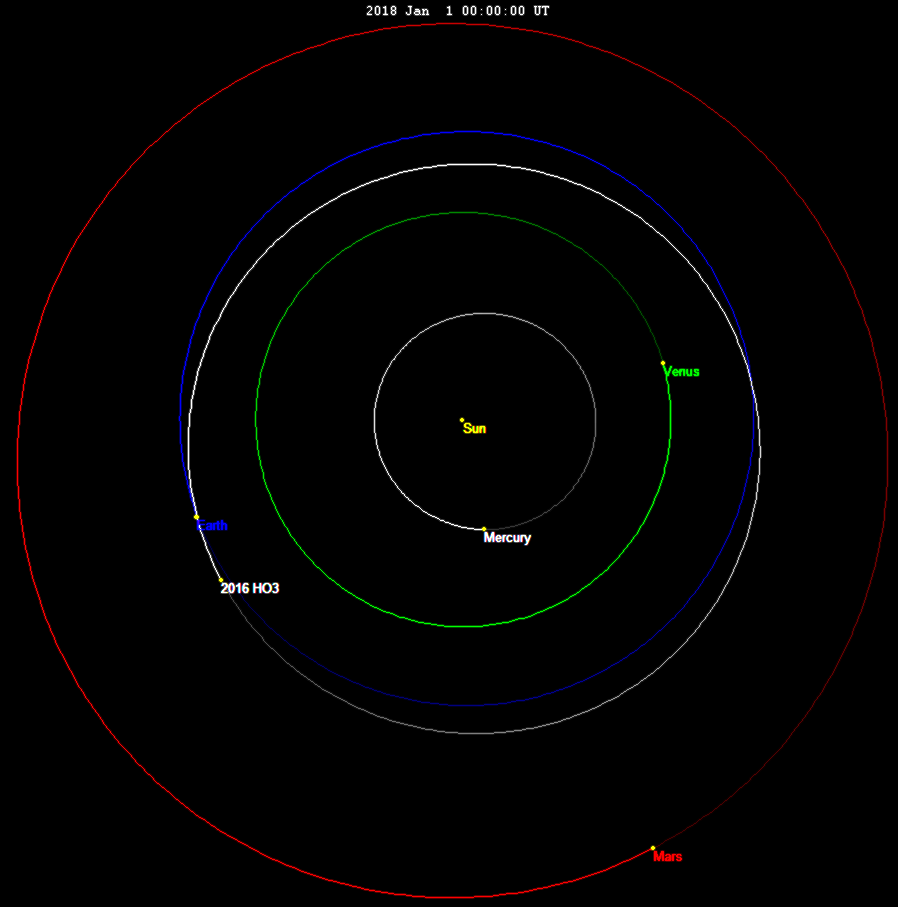
Kamo’oalewa was spotted in 2016 by the Pan-STARRS telescope in Hawaii. Its name comes from a Hawaiian creation chant and refers to an offspring that travels on its own. Astronomers describe it as a quasi-satellite. It does not circle Earth the way the Moon does. Instead, it orbits the Sun on a path very similar to ours, with a slight tilt, so from our point of view it seems to loop around the planet year after year.
Researchers at the University of Arizona estimated that the asteroid settled into this arrangement about 500 years ago and should stay in it for roughly another 300 years. Even at its closest it remains about 9 million miles away. It is also extremely faint, around 4 million times dimmer than the faintest star you can see with the naked eye on a dark night, so it can only be studied for a few weeks each April using some of the largest telescopes on Earth.
Light that looks like moon rock
In 2021 a team led by Ben Sharkey, then a planetary sciences student at the University of Arizona, used the Large Binocular Telescope on Mount Graham to split the asteroid’s reflected light into its component colours. The resulting spectrum did not look like a typical near-Earth asteroid. Instead it closely matched lunar rocks collected during NASA’s Apollo missions, a sign of rock that has been weathered by long exposure to space. The work, published in Communications Earth and Environment, suggested Kamo’oalewa was the first known near-Earth asteroid with a lunar origin.
That raised an obvious question: if it came from the Moon, where exactly? In 2024 a study in Nature Astronomy, involving scientists from the University of Arizona’s Lunar and Planetary Laboratory, ran simulations of debris thrown off the Moon by impacts. It pointed to Giordano Bruno, a crater about 22 kilometres wide on the lunar far side, as the most probable source. The crater is young by lunar standards, formed only a few million years ago. Not everyone is convinced, and some astronomers argue the asteroid could instead have drifted in from the main asteroid belt.
A spacecraft goes to collect the evidence
The best way to settle the debate is to bring material home. China’s Tianwen-2 spacecraft lifted off on a Long March 3B rocket from the Xichang Satellite Launch Center on 29 May 2025. It appears to have reached Kamo’oalewa around 7 June 2026, and in early July the China National Space Administration released a first image taken from about 20 kilometres away. The picture shows a jagged, solid looking fragment rather than a loose pile of rubble.
The asteroid is tiny. Estimates before arrival ranged from roughly 40 to 100 metres across, and early reports from the mission suggest it may be at the small end of that range. It also spins once every 28 minutes, which makes landing or hovering beside it a delicate task. The spacecraft is mapping the surface before attempting to grab material, and if all goes to plan a capsule should return a sample to Earth by late 2027. Tianwen-2 will then head out to study a comet in the main asteroid belt.
Why a moon fragment matters
If laboratory tests confirm that Kamo’oalewa is lunar rock, it would show that large impacts can throw pieces of the Moon into stable orbits near Earth, and that other such fragments may be waiting to be found. It would also give scientists a sample of the Moon that has spent millions of years exposed in space, helping them understand how sunlight and radiation alter rocky surfaces over time.
Key points
- Kamo'oalewa was discovered in 2016 by the Pan-STARRS telescope in Hawaii and is a quasi-satellite that stays near Earth as both orbit the Sun.
- A 2021 study in Communications Earth and Environment found its reflected light matches lunar rocks brought back by the Apollo missions.
- A 2024 study in Nature Astronomy named the young Giordano Bruno crater on the Moon's far side as its most likely birthplace.
- China's Tianwen-2 mission launched on 29 May 2025, reached the asteroid in June 2026 and aims to bring a sample home in late 2027.
Sources
- Near-Earth asteroid might be a little piece of the moon, Futurity (University of Arizona)
- Near-Earth Asteroid Was Blasted From a Crater on the Moon, Study Finds, Lunar and Planetary Laboratory, University of Arizona
- Tianwen 2 arrives at quasi-moon Kamo'oalewa, returns images, Sky & Telescope
Image: Tomruen, CC BY-SA 4.0, via Wikimedia Commons