
3 min read
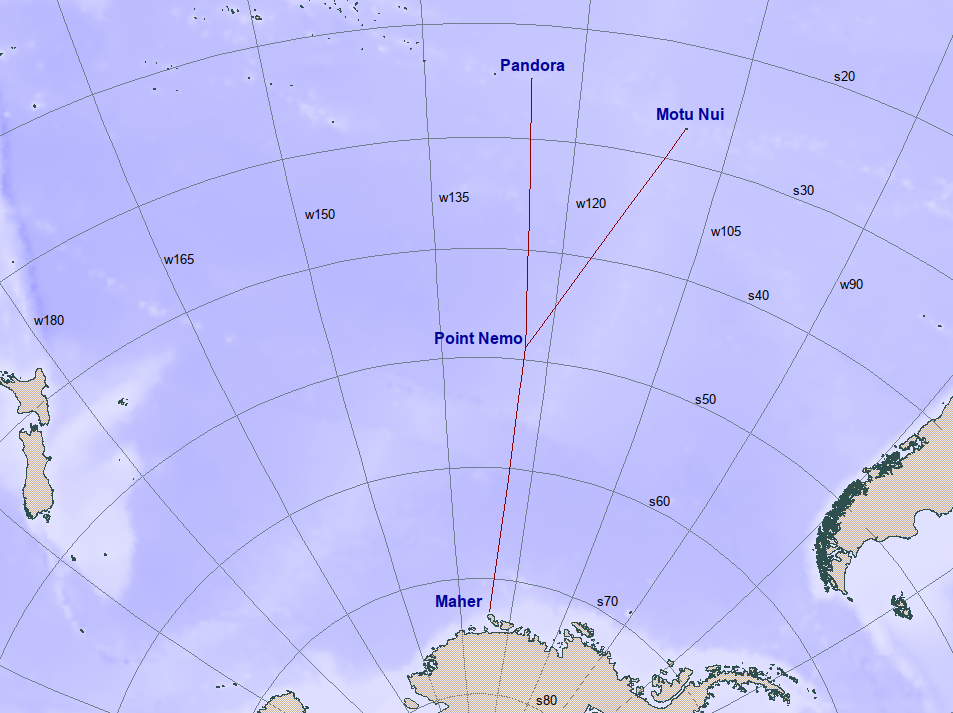
Point Nemo, at 48°52.6' S, 123°23.6' W in the South Pacific, is the ocean location farthest from land, lying about 2,688 km from the nearest coast.
Somewhere in the South Pacific there is a patch of open water that is farther from land than any other spot on the planet. It is called Point Nemo, and from there the nearest coast lies about 2,688 kilometres away in every direction that matters.
Where exactly it is
NOAA’s National Ocean Service places Point Nemo at 48°52.6′ south, 123°23.6′ west. Geographers call it the oceanic pole of inaccessibility, meaning the point in the sea that is hardest to reach from any shore.
What makes it special is that three pieces of land sit at the same distance from it. To the north is Ducie Island, an uninhabited atoll in the Pitcairn Islands. To the northeast is Motu Nui, a tiny islet just off Easter Island. To the south is Maher Island, close to the coast of Antarctica. Each lies roughly 2,688 kilometres, or 1,670 miles, from Point Nemo. Move in any direction and you get closer to at least one of them.
How it was found
Unlike a mountain peak or a river source, Point Nemo cannot be discovered by sight. There is nothing there but waves. It is a mathematical result, the centre of the largest circle that can be drawn on the ocean without touching land.
The calculation was first made with precision in 1992 by Hrvoje Lukatela, a Croatian-Canadian survey engineer. He used Hipparchus, geospatial software he had developed, to work with accurate coastline data on a model of the curved Earth. The task is harder than it sounds, because the answer depends on the exact shape of every nearby coastline, including tiny islands that are easy to overlook.
The name is a literary nod. Captain Nemo is the submarine commander in Jules Verne’s novel Twenty Thousand Leagues Under the Sea, and nemo is Latin for no one. For a place where no one lives and few people ever pass, it fits well.
A graveyard for spacecraft
The emptiness that makes Point Nemo a curiosity also makes it useful. When a large spacecraft reaches the end of its life, operators often steer it back into the atmosphere on purpose so that any surviving debris falls where it cannot hurt anyone. The waters around Point Nemo, far from shipping lanes and coasts, are the obvious choice.
The region is often described as a spacecraft cemetery. According to EarthSky, more than 260 spacecraft came down there between 1971 and 2016, including Russia’s Mir space station and several Soviet Salyut stations. NASA’s International Space Station Transition Report, published in January 2022, set out a plan to guide the ISS itself into the same remote stretch of the South Pacific when it is retired in the early 2030s.
What remoteness really means
Point Nemo is a reminder of how large the Pacific is. A circle around it with a radius of 2,688 kilometres contains no land at all, only ocean.
Very few people have ever stood on a deck directly above it. On a map it looks like empty blue. Yet that blankness is the whole point. In a world where almost every corner has been mapped and visited, Point Nemo stands out because it is defined entirely by distance from everything else.
Key points
- Point Nemo lies at 48°52.6' S, 123°23.6' W, about 2,688 km (1,670 miles) from the nearest land.
- Its three nearest neighbours are Ducie Island, Motu Nui near Easter Island, and Maher Island off Antarctica.
- Survey engineer Hrvoje Lukatela pinpointed it in 1992 using computer software.
- Its remoteness makes the surrounding area a target for spacecraft brought down at the end of their missions.
Sources
- What is Point Nemo?, NOAA National Ocean Service
- Remotest spot from land, Guinness World Records
- Where Is the Literal 'Middle' of the Ocean?, Live Science
Image: Ada Cukminski, CC BY-SA 4.0, via Wikimedia Commons