
3 min read
In October 2022 a juvenile bar-tailed godwit about five months old flew at least 13,560 km from Alaska to Tasmania in 11 days without landing, a record nonstop bird migration.
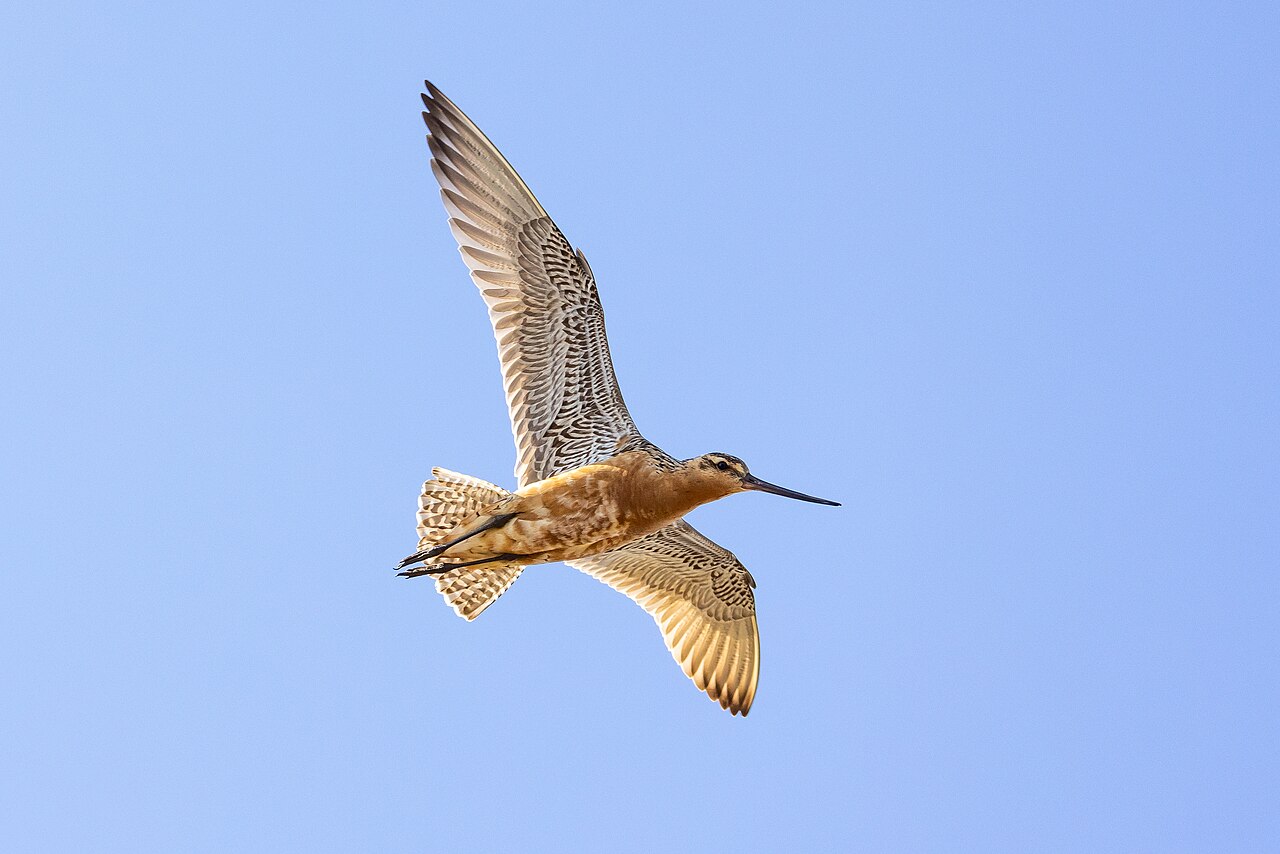
In October 2022, a young shorebird left the coast of Alaska and did not touch land again for 11 days. When it finally came down in Tasmania, it had flown at least 13,560 kilometres across the Pacific Ocean. The traveller was a bar-tailed godwit only about five months old.
The flight in numbers
The bird carried satellite tag number 234684 and had been fitted with it as a hatchling. Its sex was not known. On 13 October 2022 it set off from the Yukon-Kuskokwim Delta in southwest Alaska and headed south over open ocean. Its route took it over island groups in the western Pacific, including Vanuatu and New Caledonia, but it did not stop on any of them.
On 24 October it landed at Ansons Bay on the northeastern tip of Tasmania, Australia. The total distance of at least 13,560 kilometres beat the previous longest tracked nonstop bird flight, set by an adult male godwit flying from Alaska to New Zealand. The new record belonged to a bird making its very first migration.
How a small bird manages it
A bar-tailed godwit is a long-legged wading bird with a slender, slightly upturned bill. It feeds on coastal mudflats, not at sea, so the open Pacific offers it nowhere to refuel. Once it leaves the Alaskan coast, it has to keep flying until it reaches the far shore.
That makes fuel the central problem. Everything the bird burns in flight has to be carried on board before take-off, stored in its body. The cost is extreme. According to researchers quoted by CBC News, the young bird lost about half of its body weight during the crossing. It arrived in Tasmania far lighter than it left, having flown day and night over water the whole way.
How scientists tracked it
The record is known in such detail because of a small satellite transmitter attached to the bird. The tag used a GPS chip and a tiny solar panel, letting it keep sending location data over a long period without a battery change. Germany’s Max Planck Institute for Ornithology provided the tracking data, and New Zealand’s Pūkorokoro Miranda Shorebird Centre published a map of the route. Researchers from Massey University in New Zealand, Fudan University in China and the Global Flyway Network are involved in the wider project.
Because the tag reported positions throughout the journey, researchers could confirm that the bird never landed. They could also measure the distance from real coordinates rather than estimating it from a start and end point, which is why the figure is given as a minimum. Any detours between fixes would make the true distance longer.
Why the record matters
The flight shows that the ability to make extreme nonstop journeys is present from the very start of a godwit’s life. This bird had no previous migration to learn from, yet it navigated thousands of kilometres of featureless ocean to reach a suitable coast.
It was also the first tagged godwit recorded travelling between Alaska and Tasmania. Godwits regularly spend the southern summer in Tasmania, so many more birds are probably making the same flight each year unobserved. Tracking studies like this one help conservationists understand which coastal stopovers and wintering sites matter most. For a species that depends on a few rich mudflats at each end of its journey, protecting those places may decide whether such remarkable flights continue.
Key points
- The bird left Alaska's Yukon-Kuskokwim Delta on 13 October 2022 and landed in Tasmania on 24 October.
- It covered at least 13,560 km over the Pacific without stopping to feed or rest on land.
- It was only about five months old and lost roughly half its body weight on the way.
- A satellite tag with a tiny solar panel recorded the entire route.
Sources
- Young godwit's non-stop flight from Alaska to Tasmania (report, October 2022), CBC News
- Young godwit sets new flight record, BirdGuides
Image: USFWS Alaska, Public domain, via Wikimedia Commons