
3 min read
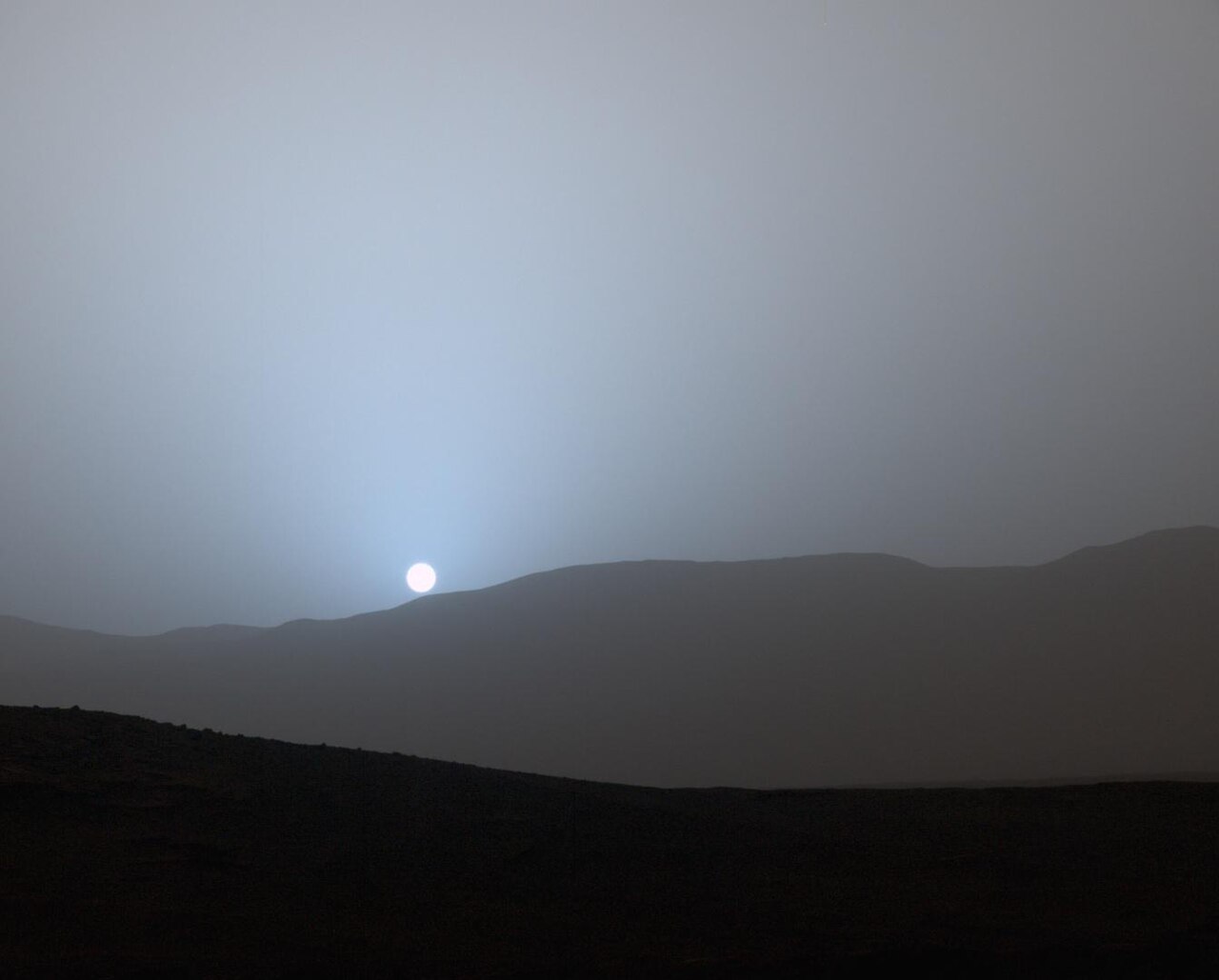
On Mars the sky around the setting Sun turns blue, because fine dust in the thin atmosphere lets blue light travel through more efficiently than red and yellow light.
On Earth, the end of the day is painted in orange, pink and red. On Mars the palette runs the other way. As the Sun sinks toward the horizon there, a cool blue glow gathers around it, while the rest of the sky stays dusty and warm in tone.
A sunset photographed from Gale Crater
The clearest view of this came from NASA’s Curiosity rover. On 15 April 2015, which was the 956th Martian day, or sol, of its mission, the rover pointed the left-eye camera of its Mast Camera at the western horizon of Gale Crater and recorded the Sun going down. NASA describes it as the first sunset Curiosity observed in colour.
The images were colour-calibrated and white-balanced to remove quirks of the camera itself, so what you see is close to what a person standing there would notice. If anything, the blue is understated. According to NASA, Mastcam sees colour much as human eyes do but is slightly less sensitive to blue.
Dust that lets blue through
The explanation lies in what fills the Martian air. The atmosphere is thin, and it carries a constant load of very fine dust lifted from the surface. Those particles are the right size to let blue light pass through more efficiently than light at longer wavelengths, such as yellow and red.
The result is a kind of sorting. Red and yellow light get spread widely across the sky, while the blue part of sunlight stays concentrated in the region around the Sun. At midday the effect is mild. Near sunset, however, sunlight has to cross a much longer path through the atmosphere to reach the ground, so there is more dust in the way and the sorting becomes obvious. A pale blue halo forms around the Sun just as it sets.
Earth works differently because our sky is dominated by gas molecules rather than dust. Those tiny molecules scatter short blue wavelengths in every direction, which is why a clear daytime sky looks blue from horizon to horizon. When the Sun is low, so much blue has been scattered out of the direct beam that mostly orange and red light remains. Mars turns that pattern almost inside out.
How scientists can be confident
The Curiosity images are not artistic reconstructions. They are calibrated photographs from an instrument designed to record colour accurately, taken by a rover with a known position and a known time of day. Because the camera team corrected for the instrument’s own colour response, the blue around the Sun can be treated as a property of the Martian sky rather than a trick of the hardware. It fits the behaviour expected from fine dust particles interacting with sunlight.
NASA also turned a sequence of the sunset frames into a short animation, showing the blue glow tightening around the Sun as it slips behind the crater rim. Watching the change over a few minutes makes it clear that the colour depends on the path length of the light, just as the dust explanation predicts.
Why a blue sunset matters
A pretty picture is a bonus, but the colour of the Martian sky is also a measurement. How light scatters depends on the size and amount of dust suspended in the air, so sky images help researchers track how dusty the atmosphere is and how high the particles reach. That matters for understanding Martian weather, for predicting how much sunlight reaches solar-powered equipment, and for planning future landings.
It also offers a useful reminder about everyday experience. The colours of our own sky are not a universal rule. They are the product of one particular atmosphere with its own mix of gases and particles. Change the air, and the sunset changes with it. On a planet with dusty skies, the last light of the day arrives in blue.
Key points
- NASA's Curiosity rover captured its first colour sunset on 15 April 2015, the 956th Martian day of its mission.
- Fine Martian dust lets blue light pass through more efficiently, so blue stays close to the Sun's disc.
- The effect is strongest at sunset, when sunlight crosses the longest stretch of atmosphere.
- On Earth, gas molecules scatter blue light across the whole sky instead, which leaves our sunsets orange and red.
Sources
- PIA19400: Sunset in Mars' Gale Crater, NASA Jet Propulsion Laboratory
- Sunset at Mars' Gale Crater (Curiosity), NASA Science
Image: NASA/JPL-Caltech/MSSS, Public domain, via Wikimedia Commons